Ads

Saturday, April 26, 2014

A Second Look @ F355 Challenge: Passione Rossa

(The things I do for a review. I knew about this game long ago because I bought it from Play N Trade. I owned it for a total of one week before taking it back. I played it for a total of 10 minutes before I was completely disappointed. I spent a total of zero hours thinking about this game from that point on. I knew I had to get this game again to review for Ferrari Month so I got it from eBay. I was willing to give it a second chance for the sake of the review but even after setting the game up through the menus I was disappointed even before I started racing. As I literally hit the first turn of Monza I knew that there was no hope for me ever liking this game.)
(Screen shots taken from Gamespot, and are the only "quality" pics that I could find)
 
Personally, I've always felt that if a game makes you work too hard without any reward it quickly becomes a chore. For example, MMOs gradually increase in difficulty the further along you are. Boss battles become more difficult as knowledge of the game world and skill utilization increases. It becomes fun through the adventure of gaining things, whether it be loot or levels, that adheres you to want to play more. With F355 Challenge the opposite occurs as the driving feels like the player's understanding of physics is put to the test with the only reward awaiting you at the end of each race is another race. No unlocks, no special modes, no surprises. In this sense F355 Challenge is completely a chore to play: you play it only if you want to, not because you feel compelled to. There is nothing to draw you in and nothing to hold your attention unless you're either intent on beating it or are a huge Ferrari fan.


Arcade and Single Play modes are the exact same, each has three different sub-levels of Training, Driving, and Racing. Training adds a recommended line and vocal assists. Driving takes you out on the field in a Time Trial where it records your best lap and ghost. and Racing (where the screen to choose this says you can "Praticipate" in a real race...) pits you against a full field of cars when you're ready for it. In Arcade mode, you can choose any of the immediately available 6 tracks out a total of 11 tracks, the remaining five are unlocked by advancing in the Championship mode, or by going ahead and unlocking them through the password codes. Championship mode is a straightforward race to cross the finish lines first. Versus play pits you against another player. Network Race makes use of the Dreamcast's dial-up modem for you to take to the track against players from around the world, but since its now defunct there isn't an option to choose this.
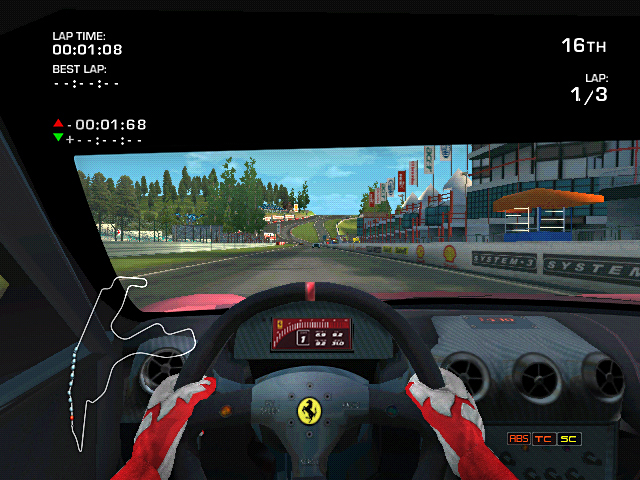
The game is more geared to be used with a steering wheel for maximum effect but doesn't hinder the playing when using the Dreamcast controller. The controller's analog pad is very accurate and better to use than the d-pad. Since there isn't an option to just look back behind your car, the game uses two of the face buttons for selecting driving assists and turning them on or off. Spin Control, Traction Control, and ABS are the usual assists you'll find along with auto-braking, using this feels like the game is holding your hand but is very necessary for those who aren't used to sim racing games. The selection for the assists could have been mapped to the d-pad while a look behind and hand brake button could have been used instead, but it seems that design flaws are abundant.

Design flaws come in all shapes and sizes and are never glitches. These are ideas that are implemented into a game during its creation that the developers put in place thinking they will be good to play with. The single in-car narrow first-person camera view that can't be changed is the biggest design flaw this game is guilty of. The length the game goes to uphold the title of racing simulator is dumbfounding. Its an idea that's good in theory, but mediocre in practice. It works, but not well. The only way you'll know when a car is behind you is either the rear-view mirror or the small radar at the top of the screen.
Graphics aren't breathtaking and it looks like the typical Dreamcast style, but its not pushing the limits of the system. It goes for a realistic graphical design and its pulled off well but it seems dark, blurred, and just visually unappealing. There is no damage and bumping into a wall will immediately turn your car into the direction you have your steering wheel. Its almost as if its saying "Oh, I'm sure you didn't mean that. Here you go, mate. Be on your way." Additionally bumping into another car on the track will result in a loss of speed for you.
The only time you get to see the car model is just before the race and the opponents on the track. Regardless of that drawback, the F355 looks accurately detailed, down to the air scoops on the side. As for the tracks themselves, a few turns missing turns here and there means that whatever you may be familiar with will have to be relearned. They don't feel like accurate representations of the real courses since they seem to go faster than what you may be used to. I may be judging too harshly as a lot of racetracks are known to reinvent themselves for the sake of keeping things new. 


The music goes for an 80's hair metal theme throughout and aside from the opening video only comes off as ANNOYING. In-race is an auditory assault where the main sounds you'll hear are the whine of the engine, the squeal of the tires, and the terrible unlicensed hair metal that the game tries to pass off as music. Its cheesy to the fullest effect and is actually distracting while driving. A radio DJ speaks at the beginning of each race to talk about the song and most of is inaudible as it quickly goes into the song. Oddly enough it goes well together, as well as a peanut butter and melted plastic sandwich.


While it tries to pass as a true-to-life racing simulator, it ends up not being a very fun game at all. There's little or no sense of progression and as far as racing simulators go it would have definitely pushed the boundaries had it been more accessible and had a willingness to not be so stuck up. Better simulation of speed rather than just handling. More options for the player and less restrictions. So what do you do when a game throws out fun for the sake of always trying to be right? Throw it out. You don't need to play F355 Challenge. What you'll find is a game that played by its own rules and ends up constantly smacking you on the back of the head to insist that you're driving wrong. Its not a terrible simulator since its adhesion to reality is commendable and it offers realistic physics on a console meant for arcade ports, but that does not excuse it for being annoying.
The Ferrari license is wasted here and how the game was popular enough to attain an arcade-exclusive sequel is mind boggling. I always do try to find the good in each game, a fair chance has to be given, but in the case of F355 Challenge I won't. With terrible physics, annoying sound, bland graphics, and bad presentation there is no hope for F355 Challenge to even be considered playable in my book. I can't think of a niche of sim racing or Ferrari enthusiasts that would find this game appealing.


Keep Playing


Saturday, April 19, 2014

A Second Look @ OutRun 2

(Images used from MobyGames, Gamespot, and IGN)

(It does say OutRun 2006, but the same songs are in both games)


The only experience I ever had with the original OutRun game was on my copy of OutRun 2. I shouldn't have to say that the great arcade classic had gone unnoticed by me for years. But my first experience with OutRun 2 was in a bowling alley arcade years ago and after just one minute in the driver's seat I surprisingly found myself loving the force feedback of the steering wheel, the bright colors that blurred by, and the freedom of the old arcade racing days. When I found out that OutRun 2 was also released on consoles I knew I had to track down my own copy of the game.
In the gaming industry "porting a game over to consoles" is a dangerous thing to do. Its either a carbon copy or a rough approximation of the previous version. OutRun 2 fits into the former and was perfectly ported over to the Xbox with added extras. It has the same feel of the arcade game and has lost none of its luster or speed. This is an arcade port done right. Perfectly, I dare say. 


OutRun 2 features three different game modes: OutRun Arcade, which is the original no-frills Arcade game; OutRun Challenge, which gives you several specific goals to achieve along each route; and OutRun Xbox Live which is currently unavailable due to the original XBL being offline. Arcade mode features the classic point-to-point race as well as the new Heart Attack mode, where you earn hearts and points for completing requests from your female passenger such as drifting through an entire zone, passing cars, or staying within a certain lane. It offers quite a challenge for both beginner and experienced players. The final mode is Time Attack, which is self-explanatory.
OutRun Challenge Mode is for those who want a little more out of their time with the game. There are 101 different missions to complete with several objectives that you take on one-by-one along each route, be it knocking over cones, staying in a lane, or racing against a single rival. Challenge Mode justifies why the arcade game was ported over and you'll find the bulk of the enjoyment here.
There is a party mode for couch co-op where you and three friends can race to outperform one another through the same series of trials found in Challenge Mode. If you have a steering wheel controller for either your original Xbox or Xbox 360 (it is backwards compatible), then that may be the best way to play it if you want that true arcade feeling.

The usual host of Ferrari pedigrees are present including the 360 Spyder, Enzo, Testarossa and 250 GTO. The best and most famous machines are here each with different stats that don't really seem to matter in the grand scheme of things. Although the cars are classified by Beginner, Intermediate, and Expert level, they're all accessible and are easy to drive. The faster cars are reserved for the more advanced players but they're also more unruly in their drift traction and handling. Regardless of that, the slower cars and easier routes may still provide a little bit of a challenge for those who are new to the concept. Traffic changes each time you play and where other cars may be present on a tight turn, they might not be there the next playthrough, giving the replayability factor a little bump. While drifting may be the big show in this game, it feels as though its pretty much the only way to get around any turn regardless of the degree of difficulty. The original OutRun was simply about avoiding traffic and not crashing into objects on the side of the road while here it could be argued for the sake of evolving the franchise that the drifting was added in and given so much attention.
There's a ton of content to unlock and play so if you're not feeling like waiting to beat each of the Challenge Mode missions there are cheats that can unlock the original unaltered Out Run arcade game and music set as well as Eurodance remixes. You pretty much have three entire games in one if you count the Xbox exclusives apart from the OutRun Arcade mode.


Graphics are crisp, clean, and bright with no frames dropped and a steady 30 fps. Even though the Xbox version is currently 10 years old, it has shown little signs of age and looks good even today. The animated menus are never bothersome to navigate and gives the entire game its own personality. Its not trying to be just another racing game, and as creator Yu Suzuki has said "it's a driving game." Understanding that brings a whole new perspective to it.
Each route you take has a different theme and you can feel immersed in this world of speed as the advertisement billboards fly by and traffic is left in your review mirror; of course you don't have enough time to stop and gaze at how each route looks but you do get the feeling that a lot of work went into the details to get them just right with no glitches and no level breaks to distract you.
Each Ferrari looks amazing with clear defining lines, shadows over the models, and an accuracy that not even Ferrari Challenge Trofeo Pirelli could achieve. However it does come across as a little lacking in the car options department: more cars could have been added to give a wider variety. The options of paint jobs on each car is a nice thought, but it doesn't give a lot to the players.


Music is plentiful and each track is worth listening to, suiting the game perfectly and giving it more of a light-hearted feeling. There might not seem like a lot of variety at first with only 9 songs to choose from but after the Eurodance remixes and original soundtracks are unlocked you have plenty of options to cruise to.
The sounds you'll hear the most are your engine's rev limits and your tires screeching along the pavement. Its never bothersome and when combined with the music it completes the game's personality. As your passenger compliments you for driving well or berates you for crashing, as you see a cityscape form over the horizon, as your engine roars at the starting line, you get the sensation that the game is alive each time you play it. Most games are weak in the sound area whereas OutRun 2 has put as much effort into sound quality as it did the graphics.

Unfortunately for me, while the arcade racing experience is thrilling, it wears on my attention span quickly. Traveling down the same road(s) in a few different cars is okay for at least 30 minutes at a time but I can't see myself putting dozens of hours into this game. You may feel the same if you're stuck playing alone, it may be better with friends though. But you can't hate this game for doing what it does. Its not a racing game, its a driving game. It set out to be its own thing and accomplished that with flying colors and most importantly it is fun even if you just want to play through Arcade Mode once. The ease of accessibility and the amount of content make this a must-own for any Xbox/360 owner. It does the OutRun name proud.
This is the definitive Ferrari racing game and is meant to be enjoyed in the same way driving a Ferrari is meant to be (minus the insane drifting, of course). Sega has done the Ferrari license justice and has re-invented a classic game, it has a lasting power for years to come and has not lost its shine throughout the years. If you don't own OutRun 2 on Xbox its never too late to find a copy since they're definitely not rare. If you prefer just a little extra than the already large amount of content here, there's always OutRun 2006: Coast 2 Coast on Xbox, PC, PS2, and PSP. These have more tracks, tuned graphics, and more music. If you're wondering how to improve a game that was already great to begin with, it would be with Coast 2 Coast. As the days of arcades and arcade games are slowing down, OutRun 2 is a treasure, it proves that games can still be fun.

Keep Playing


Monday, April 14, 2014

A Second Look @ Ferrari GT Evolution (DSiWare)


Despite what a hardcore gamer may tell you, handheld games are not the bane of gaming's existence. Gameloft, who are best known for making mobile phone games such as the Asphalt series, Marvel movie tie-ins, and the mobile versions of many Ubisoft games, have made several for Sony's consoles, the Wii, Xbox 360, iOS, and even browser-based games. Its safe to say that they are veterans of the industry but they're not huge; and while the Asphalt series may have gained a lot of ground in the last few years it's still not a game you'll find on consoles. The Ferrari GT series is on its third installment on mobile devices while Ferrari GT Evolution for DSiWare is an upscaled port of the mobile phone game from 2008. The years haven't been kind to it so it's important to remember that it's not meant to be a 20-hour life-changing epic adventure. If you have kids then it's perfect for them to play around with. If you're one of the few that miss the days of playing games on your flip phone then the nostalgic factor should make you remember the simpler days of mobile gaming, when games had a purpose and weren't as simple as just tapping your screen repeatedly.


The overall feel of the game is like a throwback to the arcade racers of the past, or more like the Need For Speed games on the Gameboy Advance where there's a strong challenge in just crossing the finish line first. Quick Race, Career Mode, and Multiplayer are the three modes to choose from. In Quick Race, you can choose from Normal Race, Elimination, Point Race, and Time Attack. Elimination should sound familiar while Point Race has you attempting to score the most points through drifting or passing other cars while still attempting to place first. Multiplayer is simple with the host choosing between the game modes present in Quick Race. You can host up to 8 people as long as they have the game installed on their DSi/3DS, but good luck finding anyone else who has this title.
Career Mode uses an in-game email system with invitations to races. You'll start by competing in amateur events until you reach the right level but it does throw in a lot of one-on-one challenges from rivals or lap time challenges presented with short reasona as to why you're racing the clock.
The top screen displays the racing action while the bottom shows the track map, car positions, and your points total. In Career Mode, points accumulate into credits which are earned by passing cars, drifting, and reaching the car's top speed. Credits accumulate to levels which earn you entries into competition races. Credits are also banked to unlock cars later. There are 32 cars including the F430, Testarossa, Enzo, and 250 GTO. 8 fictional tracks from different locales around the world such as New York, Berlin, and Tuscany all suit their real world counterparts nicely. 

There's an insane amount of drifting that's easy to control but pushing it too far will result in a spin out and possibly a loss. It feels like a nod to the OutRun series and is really quite welcome here, adding to the feel of an arcade racing game. There is a suggested driving line but the only time it changes colors is when you veer too far away from it, its ignorable since it doesn't help you by notifying when a hard corner is coming. Adjustable car options include a Steering assist to make hard corners easier, Stability Control, ABS, Road Controls, and Ceramic Brakes for better stopping power. Rain is present as a weather effect but doesn't seem to affect car performance at all. 
Trophies can be earned for various and simple things like drifting 200 meters, completing a Tuscany lap in under 2 minutes, etc. These don't count towards points or levels and are really there just for those who want to fully complete the game.
Opponent AI is dull and never offers a real challenge. They're more like moving obstacles that need to be overtaken. The only challenge that is here can be filtered down to how well you can navigate the corners and shortcuts.


The DSi wasn't the best at handling graphics since it was just a DS in a new shell. In regards to DSiWare games, its not bad for a digital title and a huge improvement over its mobile phone relative. There are no frame rate issues and the racing happens pretty fast. However the lack of flash and flare is a shame because it gives a sense that a little more effort should have been put in before giving it the go-ahead. Maybe pre-made vinyls for the cars, custom rims, colored drift smoke, something to make it stand out among the DSiWare games and to give it a more fun arcade feeling.
Cars are nicely modeled but aside from your own selected car you wouldn't be able to tell since the AI only ever seems to choose the Testarossa. Flat, rotating trees, columns, and statues are present but not noticeable unless you stop to look at them. Tracks are nicely detailed in textures but the turns are cornered off and, again, more effort should have been put into that area. Regardless of the bland textures of a bygone era, there's something pleasing about driving around the New York track with the city in the background and the lights passing by. Its all solid with no glitches and graphical hiccups.

Sounds such as the tires making noise on brick pathways, tires screeching while drifting, and car engines are just midi-files but there is no delay in their execution. Little touches such as the muffler of your chosen car thrumming a little when decelerating are there, but not necessary since you'll never drive that slow. Cars lack the ferocity of real Ferraris and have no bass to them. There's little thrill in driving something that whines as it goes down the road.
Various techno songs loop while playing but they don't have a lasting effect, aren't catchy, and make little difference if the volume is maxed or off. If just the music is turned all the way up, the music can get very repetitive quickly and soon becomes annoying. In all honesty, the sound is the weakest part of this game.


Overall Ferrari GT Evolution is a game that you can do without if you're not big on racing games since it doesn't do anything exceptional or anything new to stand out or above others on the DSi/3DS. Its simple racing and rushed game modes won't leave you with any feelings of accomplishment. Gameloft handled the Ferrari license with kiddie gloves by porting it over to DSiWare and that's a shame since having the opportunity to completely remake a game for a new platform is instead toned down with no new ideas and a big lack of imagination. The upscaling in graphics means little if you're not interested in the overall racing. But if you're one of the few that likes the old mobile racing games you used to have on your flip phone then its perfect for you with its quick career structure, open playability, and short races meant for being time-killers. These days its a small niche of people that like that sort of thing, for the rest of us, you should spend the $8 this game costs on a Virtual Console title instead.


Keep Playing.

Tuesday, April 8, 2014

A Second Look @ Ferrari Challenge Trofeo Pirelli (Wii)

(Images taken from IGN/GameSpy, because I couldn't find any good pics anywhere else.)

Years from now, when the Nintendo Wii is looked back upon, it may be remembered for at least one thing: the insane amount of shovelware that was forced upon it during its life cycle. Carnival games, mini-games, cart racers, horse simulators, fashion design games... baby simulators... (shivers). It should, for those of us who have seen it, call to mind the scene in Back To The Future Part II where Marty uses an arcade game's light gun expertly only to have one of the kids exclaim that its a baby's toy. The Wii was not treated very kindly due to some companies developing games for quick cash as though it was just a toy. So once in a blue moon a game came along that should have caused people to take notice of the system. Its also known that the Wii isn't a hardcore gamer's console, that much is obvious, so to find a sim racer that's both competent and has depth is something very rare and unexpected. Something that Ferrari Challenge Trofeo Pirelli has and does well. It may not be the same high quality title that was released for the PS3 at the same time, but what it does given the system's limitations goes above and beyond being labeled as a toy.


Featuring the six game modes of Quick Race, Arcade, Challenge, Trophy, Time Trial, and a Tutorial, which takes you around Ferrari's personal test track of Fiorano Circuit, there is more than 60 hours of gameplay for a sim racing enthusiast to take on. Quick Race allows you to jump in and test your mettle against AI opponents on a track and a car of your choice. Arcade is a long bout through four tracks with four different levels of difficulty; quitting out of this mode will restart you from the very beginning. Challenge takes you on a world tour through three international championships using the F430 for the entire duration. Trophy is the same as Challenge but you can select your own car instead. Credits are earned at the end of each race, regardless of mode while the cars are unlocked by completing events in the Challenge and Trophy Modes. There are a multitude of cars through Ferrari's 60+ year history so any enthusiast will appreciate the wide variety of Italian Stallions to choose from.
Instead of laps, each race is timed. This time can be adjusted in the options but after a 15-minute race, plus qualifying lap times, that can feel like enough for one sitting. There are only 14 tracks to choose from and the locales are from all over the world with recognizable names such as Silverstone, Paul Ricard, and Mugello. Sim racing fans will have no problems navigating the familiar turns on most of these.

Control is important when it comes to racing games and you would think that the Wiimote alone isn't very accommodating. With just the Wiimote, you can use either the tilt gestures or the d-pad to steer. This doesn't handicap the game at all and at first may be frustrating to control but after a few laps you'll find yourself getting used to the tilt method. Using the nunchuk may be the better option as it can feel more familiar to another console's controller. Weather has a great effect on gameplay as it can reduce your speed and make you lose up to an entire lap's worth of time; where normally you could push your car's limits of braking and steering, you have to remember that slick roads do play a part.
The Wii is also known for catering to arcade racing games, or those that don't use real world physics. The game can be adjusted to suit an arcade gamer's first time with a sim game up to a professional level of aptitude with adjustable levels of the Anti-lock Brakes System, Traction Control, Stability Control, and even a suggested racing line. When lowered, the first three can add bonuses to the credits payout at the end of a race. There are no upgrades to worry about, each car is a stock model to ensure each racer has a fair chance.
Opponent AI seems to drive on rails and they rarely make a mistake, it may seem to add a sense of professionalism but only if seen that way. When they do make a mistake, such as improper braking or taking a corner too wide, they're programmed to just get back on track and keep driving. Some moments opponents will actually get out of your way to let you pass rather than trying to block you, and on some rare occasions they aren't afraid to try and push you out of their way. Aside from these moments they can come off as lifeless.
Challenge cards, which are akin in-game achievements, are awarded for completing specific goals within the game such as getting a record lap, driving a certain number of miles, etc. These cards can be used in an in-game card game simply called "Challenge Cards." In this mode, you're given a random card of a Ferrari with several stats displayed underneath. These stats are compared against your opponent's card and whichever card has the better stat wins their opponent's card. Its not fun or interesting at all since the computer seems to know what you're selecting and will take several of your cards before you even have the chance to select again. Quite honestly, its a useless thing to play because you will lose every time.
Sadly Ferrari Challenge on the Wii is a single-player only game with couch co-op nowhere in sight. It probably could have benefited from having some special modes with multiple players and something else to do besides Challenge Cards because racing alone isn't very fun after a while.
The overall feel of the game has an air of professionalism with a sense that if you want to push the track's limits you will get bit. If you want to push your car's limit just to knock off a few milliseconds from your total track time then you will find a way to do it. 


Graphics are a weak point and could have used a lot of sprucing up. There are reflection problems on the car surface when near the corner markers, such as track borders reflecting on top of the car, and the full extent of the damage is limited to the bumpers and hood falling off. The cars, both in the menu and during play, look plastic with dull surfaces and inaccurate light reflections. Any vinyls added in the custom vinyl editor are badly muddled during racing, but the fact that the game has a vinyl editor should make that forgivable. Regardless of these faults there is a great sense of speed with track recreation being very accurate. No breaks, glitches, invisible walls, or disappearing walls shows that care was put into some parts of the game's graphics more than others, its not hard to notice these errors but it shouldn't detract from the racing.

A licensed soundtrack featuring 20 songs from E.S. Posthumus, Deerhunter, Black Rebel Motorcycle Club, and more span several genres so you won't have to worry about listening to an orchestral score the whole time. If the music does get irritating, you can always turn the volume down and enjoy the roar/buzz of the engines. Each engine sound was replicated directly from the real world counter-part and each car produces their own distinct tone of power. Gear heads and Ferrari fans should appreciate the extent of the effort that went into making each individual car sound as it should. Crowd announcers on each track speak the native language of the location; crowds cheer as you pass by and there's always some moron blaring an air horn whenever you approach. It gives you a feeling of "It's race day!"


Regardless of its shortcomings, Ferrari Challenge remains a double-edged sword. On one side you have a great sim racing game with depth, a sense of speed, and great attention to Ferrari details. Real effort was put into this title to make it stand out on a console that's not familiar with sim racing games. On the other there's not much challenge to it with no permanent and performance-altering damage, no heavy penalty system, and a brainless AI that leaves a hollow feeling of accomplishment that's only quelled by the fact that System-3 knew what console this was going to be on, so they held back on putting any interesting game mechanics into the mix. Its hard to compare Ferrari Challenge against the other sim racing games on the Wii when there are only two or three others out there. Its not the best racing game ever made, but it is one of the better ones on the Wii. It is steady, honest racing between cars of a world-class level. It doesn't need gimmicks to stand out and the Ferrari name is handled with care. So if you've been looking for a reason to play your Wii again, Ferrari Challenge Trofeo Pirelli is worth your time even if you're not a die-hard sim racing fan. 


Keep Playing.

Thursday, April 3, 2014

A Second Look @ Ferrari Grand Prix Challenge (NES)


Feel free to listen to this while reading this review:


Old school racing games were about as simple as you could get: select your car, select your track, mash the gas button, and don't crash while passing the field of mindless drones ahead of you. A few signs and fast-approaching corners were the only hints that you were going fast against a static background image. Ferrari Grand Prix Challenge didn't deviate from this formula (why fix what isn't broken?) and that unfortunately cements itself into the annals of racing game history as "just another old racing game." System-3 was only able to put a couple of stand-out ideas into the mix but that just wasn't enough to keep it afloat in people's memories.
Welcome to beautiful Monac-oh wait what?

Pressing select on the start screen will let you choose between either practice or will take you into a qualifying lap. If you choose to practice, you can select from any of the game's SIXTEEN(!) tracks. That amount was practically unheard of back then for an NES game. Monaco GP, Silverstone, Spa, Circuit de Catalunya, and Suzuka Circuit are among the real-world locations that have been pixelated; but while the elevation changes from each track are omitted they remain challenging if you're unprepared. At the same time the removal of elevations means that unless you know these tracks by heart, you won't recognize any of their 8-bit counterparts. There are no car variations to choose from and zero colors to customize with, the only options of automatic or manual gearbox can't be adjusted for some odd reason. You're stuck with a 3-speed automatic that isn't really automatic.
FGPC's password system is a jumbled mess of 21 characters and letters that allowed you continue the main game from a previously won race. It holds about two hours worth of playtime if followed through long enough but little to no reason to play it again.


The classic tragedy: crashing in old games


If Ferrari Grand Prix Challenge could go down in history for one thing it would be for the soundtrack that is chiptunes gold (I hope you pressed play on the video above). Before going into a qualifying lap, you can choose to turn the music off but that would mean listening to the constant hum of an engine while playing. Neil Baldwin was the composer for this game and has done the score for several other NES games like Magician, James Bond Jr, Jungle Book, and Lethal Weapon.


In the end Ferrari Grand Prix Challenge on the NES did nothing new or exciting for the old racing genre. The Ferrari license is wasted here and without it, its just another GP racing game. Even with the Ferrari name attached to it it doesn't make the boring tracks or lifeless opponents any better. While it should be remembered for having an awesome soundtrack that alone doesn't make it worth seeking out unless you want it in your collection, enjoy old racing games, or are an absolute fan of Ferrari's. 


Keep Playing.

Wednesday, January 29, 2014

Review: Real Racing 3 (Update 1.5)


Uniquity is a hard thing to pin on a game such as... wait I've said that before...

But for the sake of arguing, that holds true for Real Racing 3. Most hardcore gamers have shunned mobile gaming as being just casual distractions for the day-to-day commuter, but there are still plenty of gamers (myself included) who don't mind having something to play when a console is either out of reach or is just becoming a tired media device.
It was Christmas of last year that I received a Kindle Fire HD and the first thing I did was connect it to the Amazon Appstore to get games, among them was Real Racing 3 since it was free (I also paid for the Minecraft beta, which was a mistake).
So what's better than "free?" While Real Racing 3 has microtransactions they're not needed to progress in the game all the way through. I myself have only spent roughly $7 to get more R$ ("Real Dollars," RR3's form of currency) and gold coins but that's because I wanted to. I wanted to get a newer car and have enough coins for upgrades later on. Its possible to play through the entire game without paying anything by winning races for cash and leveling up or completing quarter-percentages of a racing series for more gold. In that sense, the term "freemium" isn't even an issue here. You can't pay to win since its all about the driver's skill level that matters once the racing starts. Here the microtransactions are only meant to get things done quicker and there's never an importance placed on either R$ or gold.


After the mention of free pricing you probably think RR3 to be light on content if you expect only fools to pay for microtransactions, and you'd be dead wrong. Featuring 77 cars from 18 different manufacturers, 23 different courses from real world locations, and 10 different event types, the game's file size of ~1.2Gs is filled to the brim with things to do. New cars are unlocked for purchase after a certain amount of trophies are won and are first offered at a discount price. (I highly recommend having enough for the initial purchase price so the discount will leave you with enough for upgrades.) You have the options to hire an agent to increase R$, a PR manager to increase fame (which increases levels), and an engineer to maintain your cars condition, all depending on whether or not you win the race. The game also features achievements for a variety of things such as number of cars owned, winning so many races in a row, leveling up, even buying a certain amount of upgrades. However these can't be shared, aren't attached to any game service, and are generally useless in the grand scheme of things.
RR3 features several different ways to customize your play style with the default being the tilt controls with auto-acceleration. There's also the options of on-screen buttons and auto-braking for the players who want to take it less seriously.
As far as physics go, the dedication to reality can be unforgiving. Grass or dirt slows you down heavily, walls can cause an undesired stopping effect if hit at a certain angle and while other cars can PIT you, they remain untouchable. After each race your car will require maintenance and, depending on how badly roughly you were driving it, the condition will deteriorate over time. A hired mechanic will fix things for a price and, on some cars, a very lengthy wait time.


It seems that "HD" graphics on a mobile device are akin to late-PS2 era graphics... OR other racing games such as Asphalt 8 Airborne are doing something right while Real Racing 3 is left in the dust. Textures are lacking in definition and upon closer inspection seem to resemble a game that's either still in beta or needs an HD texture pack as DLC. 
If all you care is the quality of graphics, then the first screenshot above has already caused you to lose all interest. While the graphics are hindered, its the gameplay that's meant to be the star. This trade-off is completely acceptable since the cars and tracks have been recreated with enough care that seeing a bland road surface should be the least of your worries.
There is a nice sense of scale upon seeing a far away wall materialize into being. Its not as bad as, let's say the original Driver on Playstation 1, but its noticeable if you look for it. Car's lights can be knocked out with ease, bumpers can be wrecked, and doors can be dented but paint remains clean regardless of how bad you wreck.


Most racing games seem to recycle or pitch-alter engine sounds to save on space. RR3 has gone the opposite (and more respectable) route by featuring a wide variety of engine sounds that match the cars being driven. The whine of the turbo, the backfire of the exhaust, the tires screeching, the tires thumping on the corner markers, and even the crashes all draw you in nicely... half a second after these things happen. There is some noticeable audio lag and while its not serious enough to break the game, it is distracting enough to break your concentration.
The music is good for the most part, until a dubstep track comes on. When will developers learn that dubstep is not good music and does not fit well within a video game? I've turned the music off and I don't mind hearing just the engines. Anything is better than dubstep.


Time-Shifted Multiplayer uses the times of other players from around the world for you to compete against in every race. Rather than directly battling other players, you're up against their total time. Instead of another racer's ghost or recorded driving habits, you're up against AI that is set to a speed that will complete a lap at a certain time. This leaves the AI completely dull and often not a threat or challenge since they brake and accelerate as though driving on wires. You can either outrun, outclass, or try and crash them to break their monotony but its pointless to try and do so when speeding past them is just fine.
Local multiplayer is present and is probably a better time when friends are near. Unfortunately I can't comment on this since I haven't played it before, but my best guess is that you can only race through the event types on a track that the host player chooses. That might be appealing to those who are serious about racing games, but let's face it: this is mobile gaming and that won't be fun for most.


As far as free games go, Real Racing 3 for your iOS, Android, and other devices is something that's definitely worth having if you're a fan of sim racing or enjoy mobile games that can hold your attention for longer than 5 minutes. All others need not apply since its not the sharpest-looking or most casual-friendly game out there with its need for dedication to long racing series and its unforgiving physics. The biggest problem that Real Racing 3 faces is its lack of ingenuity: it doesn't do anything that stands out from a big console racer when it has the opportunity to do so. It could become the definitive sim racing game for mobile platforms but instead feels content as being just another racing game based around social connectivity. Despite all of the negative, what you'll find here is a solid racing game with careful attention to physics, car data, and the players.
If you do find yourself enjoying RR3, then why not support the devs just a little and buy a $1.99 pack worth R$50,000? They've been supporting the game since launch and can easily increase the amount of content with just an update. And with thousands of other players out there constantly updating the leaderboard times, it never hurts to try and better your driving skills.

Keep Playing

Sunday, January 12, 2014

Review/Control Freak: Armored Core Verdict Day

I couldn't keep the review going for long. I'm done with this game. Welcome to a new entry into my Most-Hated Games List.


Armored Core premiered in 1997 on the original Playstation and with its combination of mech action, customization, and RPG-based credits reward system, it quickly became one of the best examples of mech simulation games to have ever been produced. The follow-up games being expansions took the game on a single-player quest and subsequently into the arenas. Fast forward 16 years later to 2013 where FROM SOFTWARE is still creating new Armored Core games and expansions. Verdict Day is not the initial release as it follows Armored Core V and even continues the story past the single-player campaign. But in these days of DLC add-ons and microtransactions, is it really worth it?


Earth is now a barren wasteland as three major corporations vie for control over territories that hold the remaining resources. The big three have worked out an uneasy truce among them but are still prepared for war with hired mechs and teams able to be dispatched at a moment's notice. The single player campaign puts you as a mech pilot working for a mercenary company when you're given the order to attack certain patrols in order to incite another war among the big three, just so they'll have reason to hire mercenaries again to do their dirty work, putting you back in a better paying job. Along the way you'll encounter other mercenary mech pilots who want to end you and the collect the bounty on your head, as you must do them also. You can form teams with AI-controlled mechs to help with completing the more difficult objectives, but it never really beefs up the difficulty enough until after about a dozen levels are completed.
If you find the single-player campaign to be too dull (and you probably will), you can open your game to the multiplayer section where you can hire other players to help you with your single player campaign missions, hire yourself out as a mercenary to help others, or have big team corporation battles (this all pending on whether the servers are up, of course, which is only half the time). And even then in the big team battles you'll come across a group of Koreans with the Windows logo who will completely obliterate whatever team is pieced together. Its this cross-cultural imbalance that makes this part of the multiplayer not even worth considering playing. They control most of the game and why servers aren't region separated is a painful reminder that FROM SOFTWARE only cares about its Far Eastern audience.
Inside the cockpit, you'll find that the action is just as chaotic and fast-paced as its ever been. Kinetic, Chemical, and Thermal Energy weapon types once again play a role in the game. Mech customization can prepare you for certain weapon types but leave you vulnerable to others. This same rule also applies for the one-on-one missions. After a short while they'll require careful planning and the right parts equipped to take down enemy mechs.
In order to advance in the story you need to defeat these other mercenaries, but when it becomes impossible to do so, it gives you no alternative to continue forward and brings the game to a grinding halt. Seasoned vets will find no fault in this and will find a way to work around it. All others will be turned off and will find no reason to continue playing. Its this exclusivity that the series has always had that prevents it from becoming something enjoyable by everyone.


The game engine is the same as 4 and 5, so you won't find much spectacle in the graphics. The whole thing is just as gritty as it was before and even though its a separate release, its already a tired view of things. With the exception of the new mech parts and the new maps, you'll find everything is the same.

The sounds of battle provide a very stark contrast to the calming nature of the menus, which features an operatic score backed by guitars. Guns in every form have different sounds and could shake the windows if turned up. The chaos of so many sounds happening on the battlefield is short-lived since some fights can take as little as two minutes.

CONTROL FREAK
Where the previous entries before Armored Core 4 were balanced between single and multiplayer, here most of the attention is on just the latter. It wants you to join a team, play through seasons, and play with others all online in order to get the better part of the experience. But what it boils down to is the same formula as the games before it: build a mech, defeat other mechs to unlock new parts, win until you have enough money to buy those new parts. It goes to show that FROM SOFTWARE has put the Armored Core series into a niche corner and shows no signs of advancing it with new ideas. Where creating teams and selling yourself as a mercenary are good ones, it seems they didn't bother to plan what to do for the rest of the game. If this is how the next few titles in the series go, with an ignorable story and a lot of repeated mech parts, then you should just ignore it. Armored Core Verdict Day is not a bad game, its a bad game to keep playing.
I looked up synonyms for the word "okay" because "okay" just sounded too dull. What I found was "acceptable," "permissible," "competent," and "satisfactory." I guess I could say that it is a competent game in that it knows what its doing but I just can't in good conscience use the others words to describe how much of a letdown Armored Core Verdict Day really is. There are other mech games that are taking the same ideas but in different and exciting directions; Hawken coming to mind first. But if this is what an old veteran of the genre has to offer then it should be put to rest for a few years.

If you have Armored Core V then you don't need Verdict Day. I understand that releasing expansions as separate games is what the series has always done but in the year of 2013 this is a tired practice. This idea of nickel-and-diming the players has already outlived its welcome. What could have been just a $20 DLC add-on was instead released as a $50 entry into the franchise. For that price the amount of content offered is simply not worth it. Companies need to understand that this will not get us to buy new games. You do not need Verdict Day. If the series continues along this path it will eventually do itself in. And maybe, just maybe, we'll get a mech game worthy of all of us playing.

Keep Playing

Saturday, December 28, 2013

A Second Look @ Unreal Championship 2: The Liandri Conflict

I'm admittedly cheating a bit by reviewing UC2, since it features a third-person camera, but since it is part of the Unreal franchise and its billed as an FPS, it counts. Deal with it.


Arriving a mere months before the release of the Xbox 360 and launching exclusively for the original Xbox, Unreal Championship 2 was once cited by one of the creators as "pushing polygons like crazy." That statement is held true as UC2 is probably one of the best-looking original Xbox games you could ever find. Epic Games made the most of it and created one of the franchise' best by taking things in a different direction with the addition of a third-person camera and melee weapons. If it doesn't sound like an Unreal Tournament game that's because its not; this offering is more balanced between the single player story and the multiplayer action by using all the content within for both sides. So much has been put into Unreal Championship 2 that its a wonder why Epic Games didn't just make it an Xbox 360 launch title. Understandably it would have been a gamble going against Call of Duty 2 in the FPS category, and by then the original Xbox was already in enough homes, so possibly sticking to the first console was a wise business decision.


This time around the single player campaign features a new tournament known as Ascension Rites. Liandri Corporation has gotten it's greedy paws into a Nakhti ritual that determines who the next king or queen will be. Enter Anubis, a warrior who gave up the princely lifestyle to fight in a far-off war which earned him the disdain of his people. He returns with the belief that the Liandri Corp has tainted the Ascension Rites through televising, marketing, and adding their own combatants into the fray. As Anubis you face your ex-betrothed Selket, her minions, and others vying for the crown through thirteen battles with various modes of play. There are four training sessions at the beginning to make sure you've got the game well understood and its easy to pick up and play by the end of them. While there are only five levels of difficulty it becomes a challenge to better yourself in the harder ones. Ascension Rites is played with Anubis only and by the end of it you feel most comfortable playing as him or someone of equal strength. Throughtout the Ascension Rites, Liandri is interfering by adding their own competitors and tipping the scales against you, including bot combatants and attacks outside of the arena, although the Ascension Rites do say that anyone can enter and win.
During the Ascension Rites ladder, Tournament legend Malcolm offers you to join the famous Thunder Crash team, and once its completed the real Tournament begins. While there are only 10 tiers with varying rules to play through, each of the fourteen characters has a tournament ladder for themselves. There's a special appearance by Raiden from the Mortal Kombat series as a tie-in with being published by Midway as well as the option to use the MK announcer.
In addition to the Ascension and Tournament modes, Challenges mode makes an appearance by offering trials wherein the player goes against several opponents on a team alone or must face off against new opponents, such as Raiden who is unlocked upon completion of all the challenges. Mods, known as mutators this time, make a comeback and take part in each of the game's modes with the series staples of Instagib, LowGrav, Speed Match, and others returning. Some new and exclusive mutators like Looting, Melee Only, and Camp Fire can make things a bit more interesting. Mutators add a level of fun and challenge that, even after many hours of normal play, can change the game in new and better ways.
DeathMatch, Team DeathMatch, and Capture the Flag being the usual Unreal game modes are present, while new modes Nali Slaughter, Overdose, and Survival make an appearance. Nali Slaughter has several competitors racing to kill as many Nali as they can while also killing or avoiding each other; its mindless fun at first but does feel like a real challenge. Overdose has players attempting to take control of an energy ball and hold it as long as they can without dying while attempting to reach a goal. More points are scored the longer the player holds onto the ball by the time they reach the goal. At the maximum dosage, the player reaches a godlike status with invulnerability, speed, and other temporary boosts. Survival pits the player or players in a one-on-one deathmatch against bots or a human opponent with the winner advancing to the next round.
Each character has their own strengths and weaknesses in regards to health and agility with four points split among the two. Those who are more agile have less health and vice-versa. Some characters, such as Anubis, are balanced. Aside from character traits, unique adrenaline power-ups can turn the tide of a fight with things like Repluse, which can shrug off some damage; Heal, which will refill a portion of the player's life bar; and Nimble, which allows the player to make several mid-air jumps in a row. Everyone has a set of temporary boosts that come at the cost of adrenaline, which is refilled slowly either automatically or via level pick-ups.
A big change for the franchise comes just before going into battle, this time the player is given a choice of only two weapons to choose from. One weapon that uses explosive ammo and the other that uses energy ammo. This forces the player to think ahead in terms of play style since the maps are too small to fit so many weapons, instead they're littered with ammo pickups of each type. The usual amount of Unreal weapons has been reduced down to eight, with series staples of Flak Cannon, Ripjack, Shock Rifle, BioRifle, and Stinger making a return. Each weapon also has they're famous alt-fire attacks to make combat more interesting.
The addition of a third-person camera adds a new depth to the playing field and allows you to see more of the action as well as a better view of the melee combat. "Bringing a knife to a gunfight" adds a whole new side to the Unreal franchise but don't think that the melee is a last resort when out of ammo. It can give you a definite upperhand in battle with the ability to charge weapons, dash through the air, shield your character, and reflect projectiles, which can add insult to injury. Along with each character having a melee weapon they also have two pistols in their arsenal with recharging ammo. When charged and released they can freeze a target in place for a short period of time, giving the player (or a bot) a few precious seconds to execute a Coup de Grace attack. These are stlyish one-hit kills with the melee weapon that are activated by pressing a button combination that's displayed.


According to Wikipedia: "A specialized version of Unreal Engine 2.5 called UE2X was used for UC2 on the original Xbox platform. It featured optimizations specific to that console." While it does feel like a true Unreal game, it seems to have lost the brooding of past titles and replaced it with a more technological look with glowing surfaces, water distortion, distance fog, and lights creating shadows and colors on the characters like crazy. It must have pushed the original Xbox to its graphical limits.
The level design is varied throughout the 40+ maps with none of the old Unreal maps making a return. This is all new stuff for a new game and the hard work shows throughout each design with amazing detail in each expertly crafted map. Distant mountains and structures look pixelated due to the technical limitations but the feeling of size and scale that's presented is mind-blowing for the console time.
The cutscenes in the Ascension Rites mode leave something to be desired in that the faces don't appear to be animated right while some textures seem to have lost a little shine that's present during play. Lighting looks good for the most part but the old FMV pixelation curse is still there. The videos do a good job of unfolding the story by introducing characters and driving the plot forward, but for those who are only caring about the action the story can be ignored.
While character diversity is a bit bland, the characters and armor designs are what you'd expect in the Unreal universe with the beefiness of the armor now becoming a mainstay in whatever Epic Games makes. Armors on Anubis, Selket, and the other Nakhti are heavily influenced by ancient Egyptian culture and look the best. All others, not so much. Besides the robots that are more appealing than previous franchise entries, the rest leave little to talk about. Regardless of that, each character design is considerably better than what was used in prior games, which they used to be recycled bodies with differing heads and colors.

The music is as dark and adrenaline-filled as you would expect from an Unreal game with techno beats, rock guitars, and orchestral instruments giving off vibes of urgency with a touch of old-school Egyptian mummy movies mixed in. While it is in tone with the Unreal universe, it feels somewhat lacking in edge and excitement as though the music is afraid to be anything less than empirical.
Voice-acting is superb with each character having several taunts, cheers, or orders when called for during gameplay while the Ascension Rites cutscenes are never too dry or phoned in. They inject a little bit of humor to keep things light-hearted and thankfully it never feels forced.
Sound effects are plentiful with grunts from the characters, distance explosions, pick-ups, gunfire everywhere, and sound distortion during a few of the adrenaline power-ups. Often times you can hunt down an elusive bot or player by following their grunts. The levels themselves never feel lifeless because there's always an environment sound happening nearby: birds chirping in open areas, the wind blowing by, footsteps through water, flames crackling, machinery motors whirring, water moving, and many other sounds give life to even the most mechanical-themed maps.


If there is a downside to Unreal Championship 2 its that it feels like just a one-trick pony. The possibility of a franchise here has flexed all its muscles with the ideas presented and for a sequel to be bigger would have to include some new and outrageous things. It would be hard to follow up and doing the next game in the same style would cause Epic Games to cement its feet and prepare to throw it in shark-infested waters. Its a conundrum: if they change it completely for a sequel then they'll be expected to keep changing with new ideas. If they keep it the same, they risk making the Championship name into a repeat offender.

I will freely admit that I have been biased in this review since UC2 is my second favorite game of all-time. Every time I put it in, even just to jump around the levels, I notice a new detail I hadn't seen before. Its easy to see why its my favorite with the amount of things to do and ways to play that make me want to play it more. The replay value is practically immeasurable if you have three friends willing to make a party of it. While the original Xbox Live may be dead, the Unreal franchise has always had bots and adjusting the difficulty feels like you'll want to better yourself. Unreal Championship 2 is only available for the original Xbox but is backwards compatible with the 360 and looks and plays best on it. You can find it incredibly cheap these days and its so very worth it to play it.
You need Unreal Championship 2 on your shelf and you need to experience this game. The ideas feel refreshing to a genre that was soon to be saturated with copy paste clones and even now it has aged well with the melee combat and character traits keeping things in a good balance with an ease of access that any FPS fan can comes to grips with.
We need to see an Unreal Championship 3 only to see more of the fresh ideas that 2 breathed into the franchise and the FPS genre in general. For it to be a follow-up to just a port of Unreal Tournament 2004 is a big deal since UC2 showed that the genre doesn't have to be stale if the developers are willing to push the limits and add new ways to play instead of how to play.


Keep Playing